GirlfriendGPT news roundup: what changed in 2026
If you have been away from GirlfriendGPT for even a few weeks, the platform will feel different when you log back in. Across the first half of 2026, GPTGirlfriend (the domain behind the GirlfriendGPT brand) has pushed through a dense string of version releases, and each one has touched a different part of the product: the chat engine, the image generator, the interface, and even the way subscriptions and coins are billed. For anyone tracking the AI companion space professionally, whether as a reviewer, an affiliate, or simply a long-time user trying to decide if it is worth resubscribing, this pace of shipping is itself a signal. GirlfriendGPT is not coasting on its original 2023 launch; it is iterating aggressively to keep pace with a crowded field that now includes Candy AI, OurDream AI, Soulkyn, LusyChat, and a dozen other companion apps all fighting for the same audience.
The most recent release, tagged v7.0.2, introduced a new lightweight conversational model called Gem 2.6. This is not a flashy, headline-grabbing model in the way “most powerful chat engine yet” announcements tend to be. Instead, it is positioned as an efficient, everyday option: strong at single-character roleplay, casual storytelling, and slow-burn NSFW pacing, while openly acknowledging it is not built for complex multi-character scenes or long-term memory-heavy sessions. That kind of transparency is fairly rare in this niche, where marketing copy usually oversells every model as revolutionary. Gem 2.6 quietly replaces an older model called Nova, which is being retired, and it is rolling out to all account tiers rather than being locked behind Elite.
Alongside the new model, the same release quietly patched a lingeri
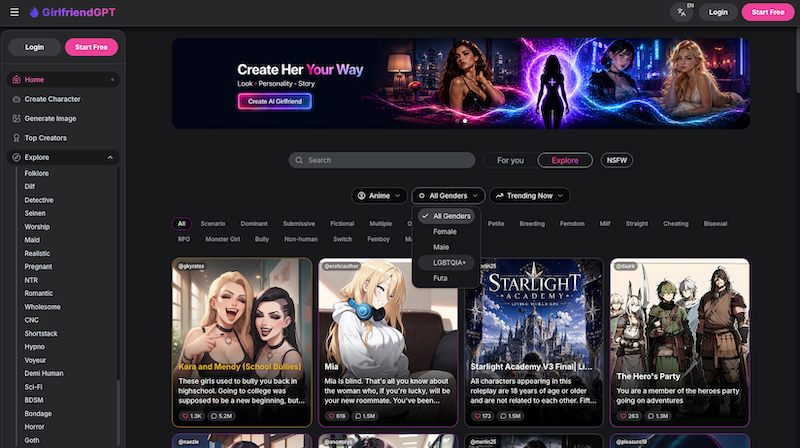
ng bug where users on non-streaming chat setups were receiving truncated final messages instead of the full response that had been streamed to them moments earlier. It is a small technical detail, but it matters in a product where conversational continuity and memory are the entire value proposition. A companion that visibly “forgets” or cuts off its own sentences breaks the illusion the whole platform is selling. The team also confirmed that the redesigned chat interface, which had been in gradual rollout for weeks, is now live for every user, with more refinements planned based on community feedback gathered in their in-app Community Chat channel.
Here is a quick-reference summary of the changes bundled into this most recent wave of updates:
- New chat model: Gem 2.6 launches as a lightweight, everyday-use model available to all users, replacing the older Nova model.
- Streaming fix: Final chat responses now match what was streamed, closing a gap where some users received shortened replies.
- Full chat UI rollout: The redesigned chat interface is now standard for every account tier, not just a test group.
- Subscription coin policy change: Coins bundled with a subscription will soon expire at the end of that billing period; separately purchased coins are unaffected.
- Continued Character Pro rollout: The upgraded image model keeps expanding its footprint across chat and profile-based image generation.
That last policy shift, tying subscription-bundled coins to the active billing cycle, is worth flagging separately, because it is the kind of change that affects retention and churn conversations more than it affects day-to-day chat quality. Users who were used to stockpiling coins across renewal periods will need to adjust their usage habits, and this is exactly the sort of detail that shows up in community forums and Trustpilot reviews long after the changelog itself is forgotten.
Gem 2.6 and the new chat model lineup
To understand why Gem 2.6 matters, it helps to look at where it sits inside GirlfriendGPT’s broader model strategy. Over the past year, the platform has steadily built out a tiered lineup: lightweight, general-purpose models available to free and Premium users, and heavier, more expensive models reserved for Deluxe and Elite subscribers. In April 2026, the platform introduced what it called its “most powerful chat engine yet” for Elite users, a model roughly three times more capable than its predecessor according to the release notes, tuned specifically for balanced, mature roleplay rather than chaotic or unpredictable outputs. That engine emphasized character consistency across multi-character scenes, improved multilingual handling, and a more deliberate pacing of NSFW content, so scenes build rather than jump straight to explicit territory.
Gem 2.6 is the opposite end of that spectrum. Where the Elite engine is about depth and consistency for power users running long, complex roleplay sessions, Gem 2.6 is about accessibility and everyday reliability for casual users who just want a natural, well-formatted conversation without friction. Reviewers testing GirlfriendGPT throughout mid-2026 have repeatedly pointed to the conversational engine as the platform’s strongest asset, often praising its ability to remember small details from earlier in a conversation and weave them back in with genuine comedic or emotional timing days later. That reputation for contextual memory and personality consistency is precisely what a lightweight model like Gem 2.6 needs to protect, even while trading away some of the raw power of the flagship engines.
This tiered approach also reflects a broader trend across the AI companion market in 2026. Nearly every major platform, including OurDream AI, Candy AI, and Soulkyn, now offers some version of a “good enough, always available” model alongside a premium, subscription-gated flagship. The reasoning is straightforward: free and low-tier users need an experience good enough to keep them engaged and eventually convert, without platforms burning compute costs running their most expensive models for non-paying traffic. GirlfriendGPT’s decision to sunset Nova in favor of Gem 2.6 suggests the older lightweight model was either too costly to maintain or simply underperforming compared to what is now available, and the company is willing to cycle through base models relatively quickly to keep the entry-level experience sharp.
It is also worth noting what Gem 2.6 explicitly cannot do well: complex multi-character scenes, deep lore-driven roleplay, long-term memory retention, and non-English conversations. For a platform whose community includes a large base of international users and dedicated character creators building elaborate, ongoing storylines, this is a meaningful limitation. Anyone running multilingual chats or juggling several companions in one scene will still need to reach for GirlfriendGPT’s higher-end models, which remain gated behind Deluxe and Elite pricing. In practice, this reinforces the platform’s existing upsell path rather than disrupting it: Gem 2.6 is a better front door, not a replacement for the rooms behind it.
Character Pro and the image generation overhaul
While the chat engine gets most of the attention, GirlfriendGPT’s image generation pipeline has arguably seen just as much investment throughout 2026. The centerpiece is Character Pro, an upgraded image model that the platform has rolled out gradually since late May, first to a subset of users and then more broadly through subsequent point releases. The core promise of Character Pro is consistency: keeping a generated image visually aligned with a specific companion’s established look, rather than producing a technically nice picture that simply does not resemble the character the user has been chatting with for weeks. This has historically been one of the most common complaints across the entire AI girlfriend category, not just on GirlfriendGPT. Users build an emotional attachment to a character’s appearance through early images or a profile picture, and then feel a jarring disconnect when later generations drift into a different face, body type, or style entirely.
Character Pro is accessible in two places: directly inside an active chat, by switching the InChat MediaGen style setting, or from a character’s profile page, using the dedicated Generate Pictures option. Both paths lead to the same underlying model, but the platform has kept them as separate entry points because usage patterns differ. Users deep in an active roleplay conversation want to type “show me” and get an image that matches the current scene without breaking their flow, while users building or refining a character from the profile page are often experimenting more deliberately with outfits, settings, and poses before committing to a look they will use repeatedly. According to the platform’s own release notes, Character Pro is meant to improve scene accuracy as well as character fidelity, meaning it should better interpret specific details like an outfit change, a particular setting, or a described mood, rather than defaulting to a generic version of the character regardless of what was asked.
This image work sits alongside a parallel investment in video. Earlier releases throughout late 2025 and into 2026 doubled the maximum length of in-chat video generation from five to ten seconds, and introduced an image-to-video feature that lets users animate any previously generated image using a text prompt. Video generation remains segmented by subscription tier, with Deluxe and Elite users getting priority rendering speed and access to higher-quality models, while Premium users are limited to a slower, lower-fidelity default model. Taken together, the image and video updates paint a picture of a platform trying to close the gap with more visually-focused competitors, some of whom have built their entire brand around photorealistic consistency, while still protecting the conversational depth that reviewers consistently cite as GirlfriendGPT’s real differentiator.
It is worth being candid that user sentiment on the visual side remains mixed. Community comments and independent reviews throughout 2026 continue to flag issues with anatomy accuracy and motion artifacts in video generations, and one recurring theme across reviews is that the interface around media generation, while improved, still feels more utilitarian than some newer, visually-polished competitors. Character Pro appears to be a genuine step forward in likeness consistency, but it has not fully resolved the platform’s older reputation for image quality trailing behind its writing quality. For anyone evaluating GirlfriendGPT against alternatives, this trade-off, exceptional chat and memory versus merely solid (not class-leading) visuals, remains the most accurate way to frame where the platform stands today.
Pricing, sales cycles, and subscription changes
GirlfriendGPT’s 2026 news cycle has not been limited to product features. The platform has run an unusually high number of promotional sales this year, and the pattern is worth understanding if you are tracking the platform for content, affiliate, or competitive research purposes. Early in the year, a Valentine’s-adjacent promotion in February gave every Premium and Deluxe subscriber temporary access to full Elite-tier features, including advanced long-term memory, doubled context window, and priority video generation, for a short window before reverting accounts back to their original plan. That kind of “try the top tier for free” tactic is a fairly common conversion lever in subscription businesses generally, and it appeared again in a Flash Sale in January offering 30% off a first month of Elite within a strict 48-hour window.
The promotional cadence continued through the spring with an Easter sale offering annual pricing discounts of roughly 39 to 60 percent depending on tier, and again in July with a sports-themed “Championship Fever” sale offering similarly steep annual discounts. For context, GirlfriendGPT’s standard tiers, at the time of its most recent reviews, sit roughly in the $12 to $33 per month range on annual billing, scaling from a Premium tier focused on core chat and image features, through a mid-tier Deluxe plan, up to an Elite tier that unlocks the strongest chat models, the fastest video generation, and the deepest memory. Coins remain the secondary currency layered on top of these subscriptions, used for additional media generation beyond what a subscription includes by default, and purchased separately from the core plan.
The most structurally significant pricing news, however, is the recently announced change tying bundled subscription coins to the active billing period. Historically, many subscription platforms in this space have allowed unused coins to roll over indefinitely, effectively letting engaged users bank a surplus during quieter usage weeks and spend it during heavier ones. Moving to an expiring-coin model for subscription-bundled coins, while leaving separately purchased coin packs untouched, is a fairly standard monetization lever: it nudges users toward consistent, period-by-period engagement rather than occasional bursts, and it protects the unit economics of the subscription tier by preventing large unused coin balances from accumulating. It is a change that will likely generate some user friction in community channels over the coming weeks, but it is consistent with how mature subscription products in the broader creator-economy and AI-companion space have evolved their monetization once they move past a pure growth phase and start optimizing for margin.
For anyone reading GirlfriendGPT reviews written before this policy took effect, it is worth flagging that older coin-related complaints and praise may no longer reflect the current system exactly. This is a genuinely fast-moving product, and given the frequency of point releases throughout 2026, roughly one every two to four weeks, staying current on pricing and coin mechanics specifically requires checking the platform’s own release notes rather than relying on a review that might already be a few months stale by the time it is read.
What this means for AI companion marketers and affiliates
Stepping back from the feature-by-feature changelog, the broader pattern in GirlfriendGPT’s 2026 roadmap is one of a platform actively defending its position in an increasingly saturated AI companion market. The frequency of releases, the tiered model strategy that gives free and low-cost users a genuinely usable lightweight model rather than a crippled trial, and the steady cadence of promotional pricing all point to a team treating retention and conversion as an ongoing, iterative problem rather than something solved once at launch. For anyone building content, comparison pages, or affiliate campaigns around the AI girlfriend vertical, this matters because it means GirlfriendGPT’s competitive position is not static. A comparison page written in January, before Character Pro’s broader rollout or the Gem 2.6 launch, would already be presenting an outdated picture of the platform’s strengths and weaknesses to readers searching for current information.
The most durable narrative across nearly every independent review published in 2026, however, has remained consistent even as the underlying models have changed: GirlfriendGPT’s core strength is conversational memory and personality consistency, not visual fidelity. Reviewers who spend multiple weeks with the platform tend to specifically call out moments where a character referenced a detail from days earlier, unprompted, in a way that felt genuinely earned rather than scripted. That is a difficult thing to fake and a meaningful differentiator in a market where many competitors lean primarily on image and video quality as their main selling point. Content built around GirlfriendGPT should lead with that strength rather than trying to position the platform as a visual-first alternative to apps like Candy AI, which have built their entire brand around photorealistic consistency.
At the same time, honest content needs to acknowledge the platform’s real friction points: an interface that, even after its 2026 redesign, still reads as more functional than polished; a coin system that adds a layer of complexity to media generation many competitors have simplified away; and a Trustpilot presence that, per several French and English-language reviews published this year, remains thin and skews negative relative to the platform’s actual monthly traffic. None of these issues are disqualifying, but presenting GirlfriendGPT as flawless will not build the kind of trust that keeps readers coming back to a review or comparison page for future decisions. The platform’s own aggressive release cadence is, in a sense, an implicit admission that it knows where it still needs to improve.
For a deeper side-by-side look at how GirlfriendGPT stacks up against the other major AI companion platforms on features, pricing, and character depth, see our full 2026 AI girlfriend apps ranking. If you want to try the platform directly, GirlfriendGPT can be accessed through gptgirlfriend.online.

Axel Taylor
AI girlfriend apps & adult tech reviewer since 2022. I test what works, skip the hype, and tell you the truth about digital companions and adult platforms. Also on sex-toys-videos.com and search4porn.com.
Clear explanation. If you need a QR for the resource, MorphQ handles it well. https://morphq.com/
Thanks ! Your site is cool however it’s nothing to deal with AI girlfriends right ?